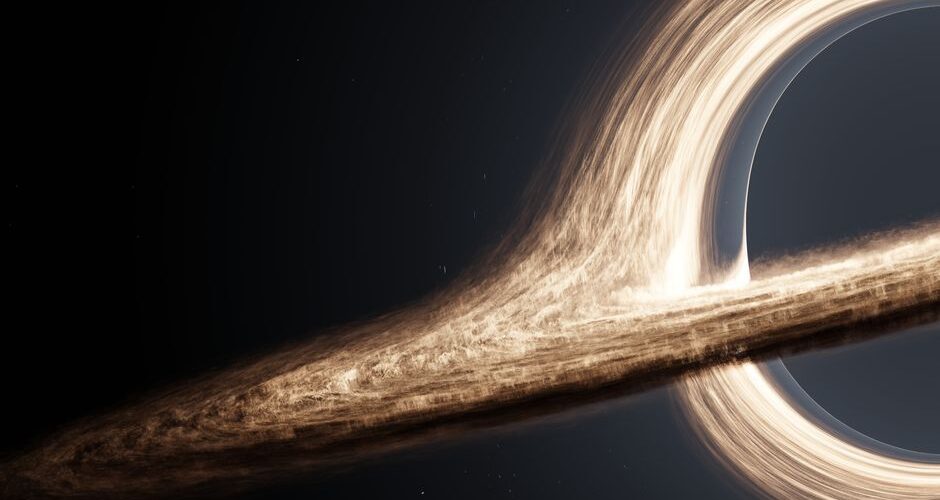
The Enigmatic Nature of Black Holes
Black holes are one of the most fascinating and mysterious objects in our universe. They capture the imagination with their incredible gravitational pull, from which not even light can escape. However, the allure of black holes extends beyond their immense density and gravity. In 2026, scientists are making groundbreaking advances in understanding how information is stored and processed in these cosmic giants through the concept of black hole holography.
What is Black Hole Holography?
Black hole holography refers to the idea that all the information about a three-dimensional object, such as a star that collapses into a black hole, can be encoded on a two-dimensional surface, much like a hologram. This theory, which emerges from the intersection of quantum mechanics and general relativity, suggests that the surface area of a black hole, known as the event horizon, contains all the information about the matter that falls into it.
It sounds like science fiction, but researchers are making strides in demonstrating the viability of this concept. The theoretical framework is rooted in the holographic principle, which posits that the entire universe can be seen as a two-dimensional information structure painted on the cosmological horizon.
Breakthroughs in 2026
This year marks significant progress in experimental techniques that could prove black hole holography. Advances in quantum information theory and improved observational technologies have allowed scientists to test these ideas with greater precision. The Laser Interferometer Space Antenna (LISA), scheduled for its first data collection flights in 2026, is expected to provide insights into the gravitational waves emitted by black holes, offering a unique glimpse into the dynamics at play on their event horizons.
Furthermore, quantum computers have reached a level of sophistication that enables detailed simulations of black hole environments, providing valuable data to support the holographic principle. These simulations are showing that the information paradox—a problem that arises when considering how information is preserved in black holes—may be resolved within this framework.
Why It Matters
Understanding black hole holography isn’t just about solving a cosmic puzzle; it’s about unlocking new realms of physics. If the holographic principle holds true, it could lead to a unified theory of quantum gravity, a Holy Grail of modern physics. This could bridge the gap between the laws governing the very large, like galaxies, and the very small, like subatomic particles.
Moreover, the implications for information technology are profound. Insights gained from black hole physics might inform the development of new data storage and encryption methods, leveraging the principles of information encoding on a holographic surface. This could revolutionize the way we manage and protect data in the future.
The Challenges Ahead
Despite these exciting developments, the journey to fully understanding black hole holography is far from over. One of the main challenges lies in the complexity of equations that describe these phenomena. Bridging the gap between theoretical predictions and empirical data is a daunting task. Furthermore, pushing the boundaries of current technologies to capture the necessary data poses significant hurdles.
Collaborations between international space agencies, universities, and private enterprises are essential. These partnerships are investing in next-generation telescopes and detectors to observe distant black holes with increased accuracy. This global effort reflects the comprehensive approach needed to tackle such a multifaceted issue.
Practical Takeaway for 2026
As we continue to unravel the mysteries of black holes, the concept of black hole holography stands at the forefront of scientific exploration. For researchers, enthusiasts, and the general public, understanding these advances offers a glimpse into the future of physics and technology. Staying informed about these discoveries not only enriches our knowledge of the universe but also prepares us for the technological innovations that these breakthroughs may inspire. 2026 is proving to be a pivotal year in space exploration, reminding us that the cosmos holds endless secrets, waiting to be decoded.