How to Build Your Own Backyard Observatory
For many stargazers, the idea of having a personal observatory is a dream come true. The allure of gazing at the cosmos, peering deep into the universe from one’s own backyard, is a captivating thought.
Building a backyard observatory may seem like a daunting task, but with careful planning and the right resources, it is entirely achievable. Whether you’re an amateur astronomer eager to deepen your understanding of the night sky or a seasoned observer looking for a more permanent setup, this guide will walk you through the essential steps to construct your personal celestial haven.
Choosing the Right Location
Location, location, location. It’s everything. The first crucial step in building your own backyard observatory is selecting the perfect site. You’ll want to find a spot that’s far enough from streetlights and other sources of light pollution.
Consider the terrain and any potential obstructions. Trees, buildings, and even hills can hinder your view of the sky. Ideally, you want a site with an unobstructed 360-degree view of the horizon. If you live in an area like Flagstaff, Arizona, known for its dark skies, consider yourself lucky. For others, a light pollution map can be a handy tool to find the best possible location in your vicinity.
Designing Your Observatory
Once you’ve secured your location, it’s time to design the observatory. The design largely depends on your specific needs and budget. Here are a few popular designs:
- Roll-Off Roof Observatories: These are incredibly popular among amateur astronomers. The roof rolls back to expose the sky, allowing for easy access to celestial views. They are often easier and cheaper to construct than domes.
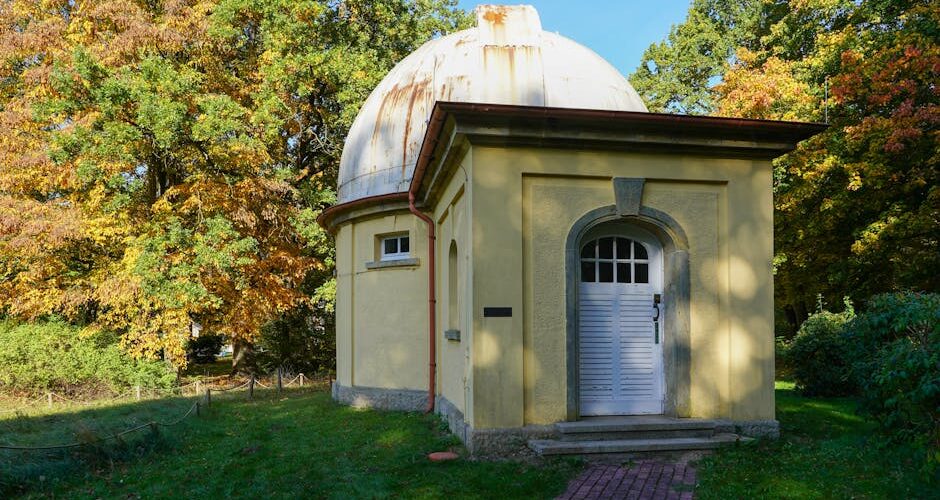
- Dome Observatories: If you envision a more traditional observatory, a dome might be the way to go. Although they can be more expensive and complex to build, domes provide excellent protection from the elements and a controlled observational environment.
- Portable Observatories: For those not ready to commit to a permanent structure, a portable observatory could be a viable option. These structures provide flexibility and can be set up or dismantled as needed.
Materials and Construction
Building your observatory involves selecting the right materials. For the structure, you might use wood, metal, or fiberglass, depending on your design choice and local weather conditions. Ensure that the materials are robust enough to withstand the elements, especially if you live in areas prone to harsh weather.
For the base, consider a solid concrete foundation to ensure stability and reduce vibrations. The telescope mount is another critical component. Opt for a sturdy, well-aligned equatorial mount or a computerized alt-azimuth mount based on your requirements.
Outfitting with the Right Equipment
Your observatory’s primary purpose is to house astronomical equipment. Choosing the right telescope and accessories can make all the difference in your stargazing experience. Here are a few pointers:
- Telescope: Selecting a telescope depends on your interests. For planetary observation, a high-quality refractor or compound telescope is ideal. For deep-sky observations, consider a reflector with a larger aperture.
- Mounting: As mentioned earlier, a solid mount is essential. A computerized mount can enhance your observation sessions by allowing precise tracking of celestial objects.
- Accessories: Eyepieces, filters, and a good camera are valuable additions. Consider investing in a CCD or CMOS camera for astrophotography if capturing the beauty of the universe is part of your goal.
Automation and Technology Integration
In the age of technology, automating your observatory can significantly enhance your stargazing experience. Consider integrating software that allows you to control your telescope and camera remotely. Popular software options like Stellarium or Starry Night can help plan your observation sessions effectively.
Moreover, smart home systems can be applied to automate lighting and climate controls, ensuring that your equipment stays in optimal condition year-round.
Practical Takeaways
Embarking on the journey to build your own backyard observatory is as rewarding as it is challenging. By carefully considering location, design, materials, equipment, and technology, you can create a personal gateway to the stars. Whether you’re capturing stunning images of the Milky Way or simply enjoying a quiet night under the stars, your backyard observatory will be your private sanctuary for celestial exploration.