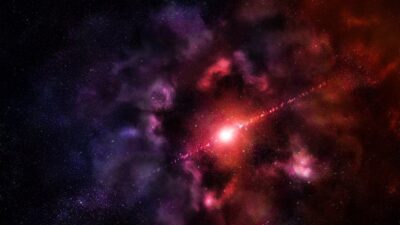
The Enigmatic Nature of Dark Matter
In the cosmos, visible matter, the stars and planets we can see, represents only a small fraction of the universe. The rest? It’s a mysterious substance known as dark matter, and it’s now under the spotlight like never before. In 2026, scientists have made substantial headway in understanding this elusive component that makes up approximately 27% of the universe. Dark matter is invisible, doesn’t emit light or energy, and is detectable only through its gravitational effects. But why is it so crucial?
New Detection Techniques: A Breakthrough in 2026
This year marks a significant leap forward in dark matter research, thanks to innovative detection techniques. At the forefront is the Deep Underground Neutrino Experiment (DUNE) based in South Dakota, USA. This massive international project, involving over 1,000 scientists from 30 countries, is using its state-of-the-art neutrino detectors to catch glimpses of interactions with dark matter particles. Alongside, the Large Hadron Collider’s (LHC) recent upgrades have allowed physicists to simulate conditions similar to the Big Bang, offering clues to the origins and properties of dark matter.
The Role of Gravitational Lensing
Gravitational lensing, where dark matter bends the light from distant galaxies, has become a pivotal tool in mapping the dark universe. The European Space Agency’s Euclid satellite, launched in 2023, has provided high-resolution images that reveal how dark matter clusters around galaxies. This has given astronomers new insights into the distribution of dark matter and its role in the formation of cosmic structures.
Dark Matter and the Cosmic Web
Researchers are delving into how dark matter interacts within the cosmic web, the vast network of filaments and voids that structure the universe. Using simulations from the IllustrisTNG project, a consortium of researchers is exploring how dark matter influences galaxy formation and evolution. The data from these simulations, combined with observational data, suggest that dark matter plays a pivotal role in stabilizing galaxies and influencing their shapes and sizes.
The Implications for Our Understanding of the Universe
Understanding dark matter isn’t just an academic pursuit. It holds the key to unraveling the mysteries of the universe’s origin, its current state, and its future. The potential discovery of dark matter particles would revolutionize physics, potentially leading to new technologies and energy sources. Moreover, mapping its distribution can help us understand phenomena like galaxy collisions and the expansion of the universe.
Practical Steps for Aspiring Cosmologists
If you’re captivated by the mysteries of dark matter and eager to contribute to this exciting field, there are several pathways. Engaging in academic programs focused on astrophysics or cosmology is an excellent start. Participating in research projects, internships, or collaborations with institutions involved in dark matter research can provide invaluable experience. Staying informed about the latest developments through scientific journals and conferences will keep you at the forefront of discoveries.
Dark matter may be invisible, but its impact on our understanding of the universe is profoundly tangible. As 2026 progresses, the veil over this mysterious substance continues to lift, promising to transform our cosmic perspective.